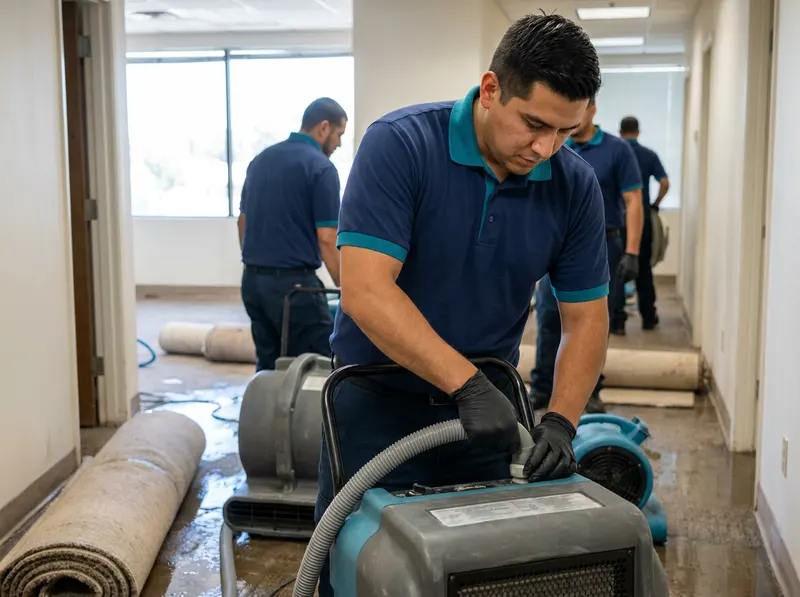
Multi-unit and commercial water losses differ from single-home jobs because water migrates vertically and horizontally through shared construction. A pipe burst on an upper floor of an apartment complex near Fig Garden or a fire-sprinkler discharge in a Tower District retail unit can saturate 3, 4, or more units below it within hours. Restoration for these buildings maps moisture in every affected unit, not just the one where the leak started, using moisture meters and thermal imaging to trace water inside wall cavities, subfloors, and drop ceilings before it feeds mold growth. Fresno's summer heat regularly runs past 100°F from June through September, which accelerates microbial growth in trapped moisture, so drying is treated as time-critical rather than optional.
Scale drives the equipment list. A single flooded office suite off Shaw Avenue may dry with a handful of air movers and one dehumidifier, while a saturated ground floor across a multi-tenant building can require 30 or more air movers, multiple LGR dehumidifiers, and a truck-mounted extraction unit. The three-water-category standard used across the restoration trade guides handling: Category 1 is clean supply-line water, Category 2 is gray water from appliances, and Category 3 is contaminated black water from sewage backups or ground flooding, a common issue in older Fresno properties near the San Joaquin River basin and in buildings with aging cast-iron drain lines. Category 3 work requires containment barriers and antimicrobial treatment, which raises both cost and timeline.
Decision-fit runs on scope. If the loss is confined to one tenant space or a single retail unit under about 1,500 square feet, a standard commercial drying setup restores it in roughly 3 to 5 days. If water has crossed into multiple stacked apartments or flooded a shared corridor and stairwell, the job becomes a phased multi-unit project with staged drying, tenant coordination, and separate documentation per unit, often 1 to 3 weeks depending on reconstruction. The trade-off is straightforward: a fast single-unit dry-out keeps one tenant offline briefly, while a full multi-unit restoration protects the whole building envelope but requires access scheduling with occupants and property management.
Each affected unit is documented separately with moisture readings, photos, and equipment logs, because commercial and multi-unit claims are usually filed through building or landlord policies that require per-unit itemization. Crews coordinate directly with property managers and can work around occupied tenant spaces, sealing off wet zones so unaffected units in a Fresno complex stay operational during drying.